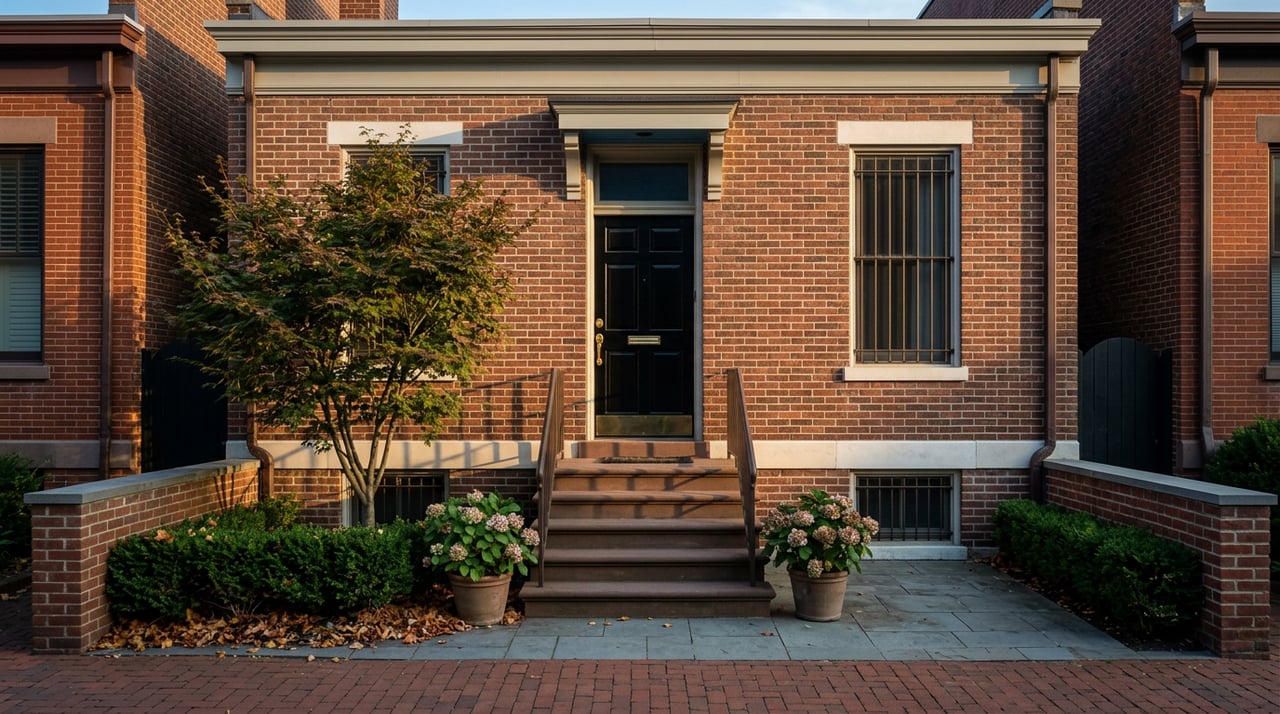
What Wilmington's City Wage Tax Means for Homebuyers
September 3, 2026
September 3, 2026
Ask a buyer comparing two houses in the Wilmington area what separates them, and they will reach for the usual tools: price per square foot, days on market, maybe the width of the lot. Almost nobody asks a more basic question first. Does this address sit inside the city line, or just outside it?
That single distinction does more to a household's annual cost than most of the numbers on a listing sheet. It changes the property tax bill, yes, but it also changes the tax return, because, as USA Paycheck notes, Wilmington is the only municipality in Delaware that collects a local tax on earned income. A rowhome in the city and a similar house four blocks away in unincorporated New Castle County can carry nearly identical price tags and still cost two different households two different amounts every single paycheck.
Delaware has no local income tax anywhere except Wilmington. The City of Wilmington says residents pay a flat 1.25% wage tax on earned income, and so does anyone who works within city limits, whether or not they live there.
That detail matters most to a specific kind of buyer: the relocating professional deciding between a home inside Wilmington and one just outside it, in Brandywine Hundred or Talleyville, while still commuting to a job downtown. Moving four blocks outside the city line does not exempt that paycheck.
A simple way to see how the tax actually falls:
| Where you live | Where you work | Wage tax owed |
|---|---|---|
| Inside Wilmington | Inside Wilmington | 1.25% on all earned income |
| Inside Wilmington | Outside Wilmington | 1.25% on all earned income |
| Outside Wilmington | Inside Wilmington | 1.25% on income earned in the city |
| Outside Wilmington | Outside Wilmington | No local wage tax |
The only household that avoids the tax entirely is one that lives outside the city and works outside it too. Everyone else owes something, and city residency is the one condition that guarantees it applies to every dollar earned, regardless of where that paycheck comes from.
Buyers shopping with an eye toward investment property, a home office, or a small business may also want to consider the net profits tax. The City of Wilmington’s FY2027 budget summary says the city charges a 1.25% tax on the net profits of business partnerships, professional associations, and limited liability companies, the same rate as the wage tax, set by the Delaware General Assembly.
For a buyer weighing a Wilmington address against one just outside it while also running an LLC or a small professional practice, this is a narrow provision to consider when comparing the costs of a Wilmington address with one just outside the city.
Wilmington's residential property tax rate held flat for fiscal year 2027, which began July 1, 2026: $3.7413 per $1,000 of assessed value, unchanged from the year before. Non-residential property carries a rate of $5.8276 per $1,000. Mayor John Carney signed the budget with no increase, and the City Council approved it 11 to 1.
The city kept the rate flat by drawing $2.6 million from its Tax Stabilization Reserve Fund rather than raising the rate. Carney has said publicly that leaning on reserves this year could make next year's budget process more difficult.
As Spotlight Delaware reported, the reason the rate needed steadying traces back to 2024, when New Castle County ran its first full property reassessment since 1983. Four decades of quiet drift in assessed values corrected itself in a single cycle, and the fallout landed hardest on Wilmington homeowners. The city's initial response, a flat $4.55 per $1,000 rate proposed that March, drew enough pushback that the administration walked it back to the current $3.74 residential rate before the budget could pass.
Spotlight Delaware quoted a Wilmington resident at the council meeting as saying:
"The new reassessment is not helping us, it's hurting us."
Another resident told the council his lot had been assessed by the county's contracted vendor, Tyler Technologies, at $375,000, despite having purchased it for $45,000 in 2018. Spotlight Delaware reported that City Council President Ernest "Trippi" Congo called the reassessment "evil." That is the kind of change a reassessment can produce, and it provides context for this year's flat rate.
A short timeline makes the sequence clearer:
The reassessment aftershock has not fully settled. The city has announced plans to contract a third-party organization to conduct interior assessments specifically in neighborhoods that have seen the sharpest increases in property values, a plan presented to a Joint Committee of the Delaware General Assembly in September 2025. The city has also said it will fund appeal assistance for low-income residents and verify the methodology behind commercial reassessments.
For a buyer eyeing a Wilmington block that has visibly appreciated in the last few years, this is worth knowing before making an offer, not after the first tax bill arrives. Fast-rising valuations are precisely the neighborhoods this initiative is built to examine more closely.
There is a counterweight worth mentioning too. The City of Wilmington offers a property tax exemption on the first $210,300 of assessed value for homeowners 65 and older who qualify by income, along with a discount on water and sewer bills. It will not offset the wage tax question for a working household, but it matters for buyers thinking about where a parent might downsize, or for anyone planning to stay in a Wilmington home well past their working years.
Put the pieces together and the comparison a buyer actually needs looks different from the one most people run. Two households earning the same combined income, one living inside Wilmington and one living in unincorporated New Castle County just outside it, are not paying the same annual cost even if their mortgage payments are identical. The household inside the line owes 1.25% of every earned dollar in wage tax that the household outside the line, working outside the city, does not owe at all. On a combined income of $120,000, the wage-tax difference is roughly $1,500 a year.
Add the property tax rate to the comparison. For two similarly priced homes on either side of the Wilmington line, a more complete comparison considers total occupancy cost, including both the paycheck and the property.
Is Wilmington's property tax rate going up this year? No. The FY2027 budget, effective July 1, 2026, held the residential rate at $3.7413 per $1,000 of assessed value, with no increase.
Do I owe the wage tax if I live outside Wilmington but work inside the city? Yes. The 1.25% wage tax applies to anyone who works within city limits, regardless of where they live.
Is there a similar local income tax anywhere else in Delaware? No. Wilmington is currently the only municipality in the state with a local wage tax.
What if I'm 65 or older? Wilmington offers a property tax exemption on the first $210,300 of assessed value for qualifying homeowners 65 and up, along with a discount on water and sewer charges.
Comparing homes across the Wilmington city line means comparing two different cost structures, not just two different price tags. That is exactly the kind of detail worth working through with someone who watches this market from both sides of the boundary. Joshua Hutchinson works with buyers across Delaware, Pennsylvania, Maryland, and New Jersey, and can walk through what a specific address, on either side of that line, actually means for your budget. Let's Connect.
This article is general information, not legal, tax or financial advice. Consult a qualified professional about your situation.
Stay up to date on the latest real estate trends.

Get assistance in determining current property value, crafting a competitive offer, writing and negotiating a contract, and much more. Contact Joshua today to discuss all your real estate needs!