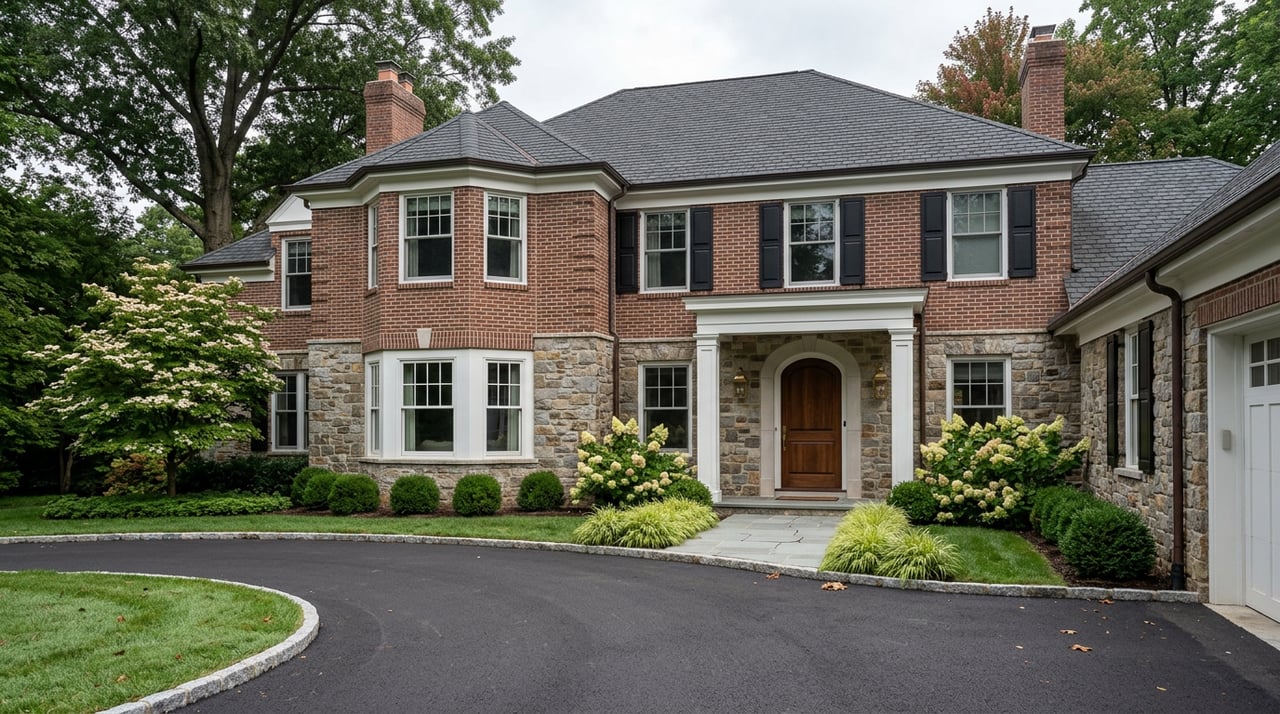
New Castle County Delaware Home Buying Costs Beyond the Price
July 23, 2026
July 23, 2026
A buyer relocating from Cherry Hill signs a contract for a $500,000 colonial in Hockessin. A second buyer, moving from Bel Air, signs on an equivalent $500,000 house in Pike Creek. A third, coming from West Chester, picks a similar home in Middletown. Same price on the portal. Same monthly payment on the pre-approval letter. Three very different amounts of money leaving the buyer's account at settlement.
That gap is not a rounding error. It is the piece of a New Castle County move that never appears on a listing page, and it is the reason median-price comparisons across state lines quietly mislead the people who rely on them most: relocating households comparing Delaware to Pennsylvania, Maryland, and New Jersey.
Delaware's realty transfer tax is the single largest closing-cost surprise in the region. In New Castle County the combined state and county rate is 4% of the sale price, made up of a 2.5% state portion and a 1.5% county portion. That is among the highest transfer-tax rates in the country, and it applies to essentially every arm's-length residential sale.
Here is what that means on a $500,000 purchase, holding price constant across four states in the corridor Joshua works:
| Location | Approx. total transfer tax on $500K |
|---|---|
| New Castle County, DE | $20,000 |
| Maryland (typical county) | ~$5,000 |
| New Jersey (typical) | ~$3,000 |
| Pennsylvania (state + local, most townships) | ~$10,000 |
The Delaware figure is not a fee tucked into title insurance. It is a line item collected at settlement, recorded on Form 5402 by the New Castle County Recorder of Deeds, and split by default between buyer and seller. On a $600,000 home in New Castle County the total transfer tax comes to $24,000. On a $350,000 home it is $14,000.
That is the number the median hides. When a buyer looks at Delaware's median sold price of $381,000 in March 2026 and thinks it looks reasonable compared with southeastern Pennsylvania, they are seeing the sticker, not the tax stamp.
Under the standard Delaware Association of Realtors purchase contract, the 4% is split 50/50 between buyer and seller. Each side pays 2%. On a $500,000 resale in Hockessin, that is $10,000 out of the buyer's pocket at closing and another $10,000 off the seller's proceeds.
Two situations change the math:
Builder contracts. New-construction buyers in communities across Middletown, Bear, and the Route 40 corridor rarely sign the DAR form. Builders write their own agreements, and many of them shift the entire 4% onto the buyer. On a $600,000 new build, that is $24,000 the buyer owes instead of $12,000, a $12,000 delta that almost never appears in the sales-center pro forma. A buyer walking a model home should ask, before anything else, how transfer tax is allocated in the builder's paperwork.
Concessions in a softer market. The 50/50 default is negotiable in the contract. In markets with rising supply, buyers can and do write offers asking the seller to absorb a larger share of the transfer tax as a credit. Whether that ask lands depends on how much competition the listing is drawing, which brings us to the second thing the median hides.
New Castle County is Delaware's tightest residential market. As of March 2026, per Delaware Association of Realtors MLS data, the county was running 34 days on market, 3.6 months of supply, a 97.1% sale-to-list ratio, and a median sold price up 8.5% year over year. Sales volume in New Castle itself for June 2026 came in at 124 homes, off slightly from 132 in June 2025.
A 97.1% sale-to-list ratio means the average buyer negotiated the price down by less than 3%. That is not a buyer's market at the price line. That is a market where the leverage is somewhere other than the asking price.
Where is it? In the closing-cost stack. Delaware Public Media reported earlier this spring on a Delaware transaction in which the sellers agreed to their full asking price but credited $22,000 toward the buyers' closing costs. That kind of concession would have been almost unheard of during the 2021-2022 surge. Today it is the negotiating room that actually exists in New Castle County, and it maps directly onto the transfer-tax problem. A buyer who cannot chip the price down 5% can often ask a motivated seller to cover an additional 1% to 2% of the transfer tax, or to pay for deed preparation, or to fund an inspection credit. On a $450,000 home in Bear or Pike Creek, that is the difference between showing up to closing with $18,000 and showing up with $10,000.
The information gap for out-of-state buyers is that they arrive expecting to negotiate the way they would in Chester County or Cecil County, where the transfer-tax stakes are smaller and the sale-to-list ratio tells a similar story. In Delaware, the same 3% haggle is worth more because it is layered on top of a much heavier statutory cost.
Delaware offers a targeted first-time-buyer reduction: the buyer's share of the state transfer tax drops by 0.5% on the first $400,000 of the purchase price. On a $400,000 primary residence that saves a qualifying buyer up to $2,000 at settlement, applied directly on the settlement statement rather than as a refund.
Three limits catch relocating buyers by surprise:
The point is not that the credit is bad. It is that a $2,000 credit sits inside a $16,000 tax bill on a $400,000 house. First-time buyers should claim it. They should not budget around it.
Delaware requires a licensed Delaware attorney to conduct residential real estate closings. Buyers coming from Pennsylvania and New Jersey, where title companies handle most settlements, are often surprised to learn that they need to engage settlement counsel early, and that the attorney's fee is a separate closing-cost line. Practically, this adds two things to the transaction timeline: a specific vendor to book before contract, and a document workflow that can extend the typical 30-to-45-day close if the file arrives late. For anyone stitching together a sale in one state and a purchase in Delaware on the same day, coordinating the attorney is not optional.
If you are comparing a New Castle County purchase against a same-priced home in Chester County, Cecil County, or a South Jersey town, do this before you get emotionally attached to a listing:
Two houses with the same asking price in two different states can differ by more than $15,000 at the closing table before you have paid a dime toward the mortgage. That is the number to compare.
Is the 4% negotiable? The tax itself is statutory. The split between buyer and seller is negotiable in the contract. The DAR form defaults to 50/50; builder forms often do not.
Does the first-time-buyer credit apply if I owned a home in another state? No. The credit is available only to buyers who have never previously held an ownership interest in residential real property, including outside Delaware.
Do I really need a Delaware attorney at closing? For a residential purchase in Delaware, yes. Book one early, especially if you are coordinating a same-day sale in Pennsylvania or New Jersey.
Where can I verify the current rates? The New Castle County Recorder of Deeds publishes the transfer-tax forms and current guidance, and the Delaware Division of Revenue maintains the statewide realty transfer tax reference.
If you are weighing a move into New Castle County from Pennsylvania, Maryland, or New Jersey, the questions worth answering are not on the listing page. They are on the settlement statement. Joshua Hutchinson is licensed in all four states and can walk you through the true cost of a move before you write the offer, not after. Let's Connect.
Stay up to date on the latest real estate trends.

Get assistance in determining current property value, crafting a competitive offer, writing and negotiating a contract, and much more. Contact Joshua today to discuss all your real estate needs!